Selling tickets feels great.
You launch the event and push the page live. Suddenly it’s out there. Registrations are open. Tickets are available. People can actually buy their way in.
That’s the moment it starts to feel real.
There’s a shift that happens when you hit publish. The event stops being an idea and becomes something you actually have to deliver.
Now the pressure kicks in.
Suddenly, your brain is running through a hundred different things at once. Do we have the latest guest list? Has the venue confirmed the updated numbers? Who’s updating the run sheet? Did anyone follow up with the supplier about delivery times?
We’ve all been there, right?
Ticketing platforms help you open the door. They’re good at selling tickets, collecting payments, and managing registrations. But once ticketing is live, most of the real work moves somewhere else.
The guest list ends up in a spreadsheet. The run sheet lives in a document. Tasks get tracked in another tool. Supplier details sit in email threads. Before long you’re jumping between platforms just to understand what’s happening with your own event.
Sometimes it works. Until it doesn’t.
You know that moment when someone asks a simple question like, “How many guests are we expecting now?”
You open the ticketing system. Then the spreadsheet someone updated yesterday. Then another version someone shared with the team.
And for a second your stomach drops.
Because you realise you’re not completely sure which one is right.
It’s not a great feeling. Not because you don’t know how to run events, but because the information is scattered. When your planning tools don’t connect, you end up becoming the system that holds everything together.
Most organisers build their own workaround. A spreadsheet for guests. A document for the run sheet. A task board for the team. A folder somewhere for supplier details.
It works when events are small or timelines are relaxed.
But the bigger the event gets, the more pressure that system puts on you. Instead of focusing on the event itself, you spend more time chasing information and checking that everything still lines up.
And that’s exactly the problem Circolo was built to solve.
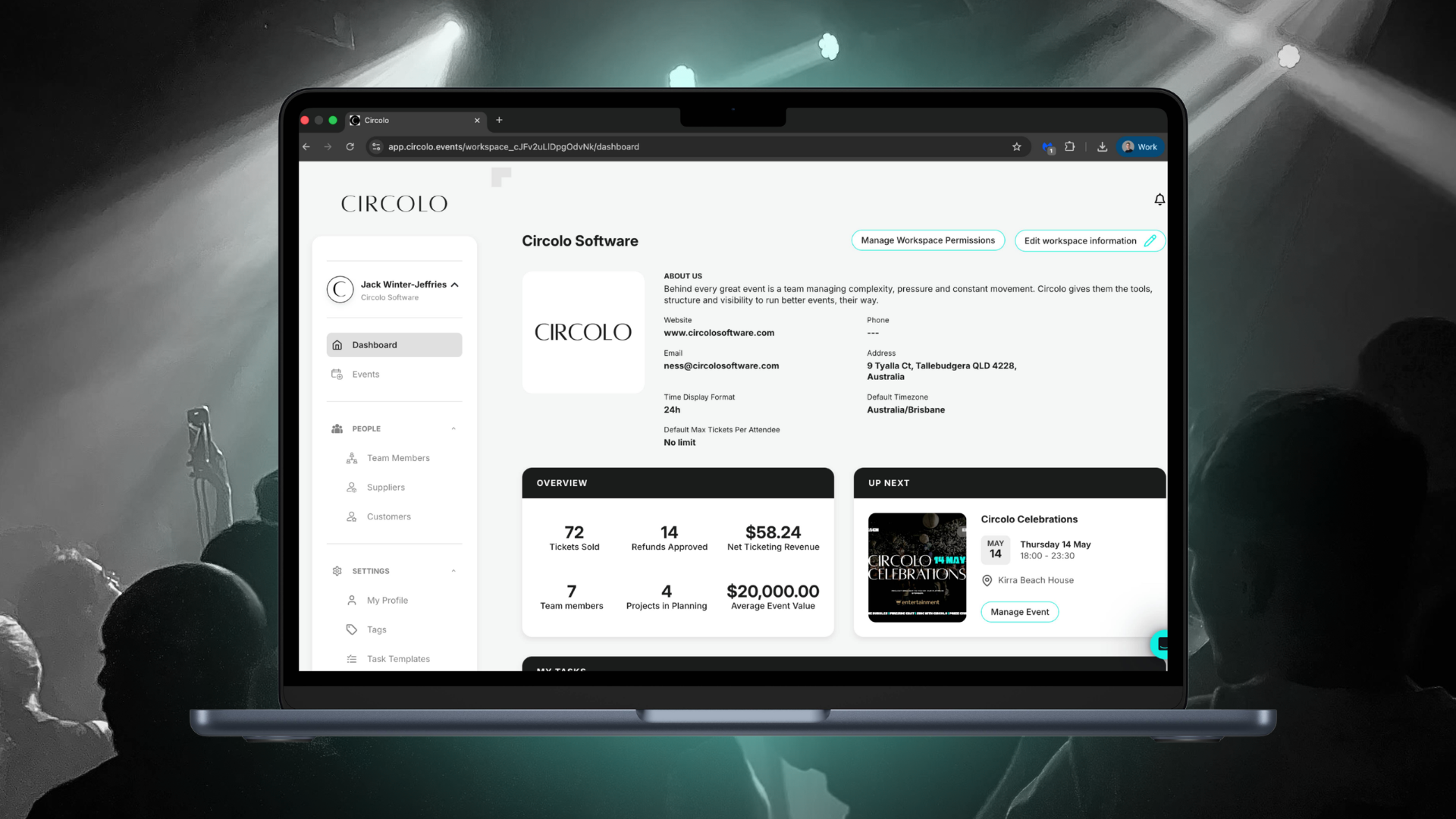
Instead of selling tickets in one place and planning the event somewhere else, Circolo brings everything together. Ticketing, guests, tasks, suppliers, budgets, and run sheets all live in the same platform.
So when someone asks how the event is tracking, you don’t need to open five different tools to answer.
You already know.
At the end of the day, ticketing is only one part of running an event. Guests only see the ticket, but organisers know the real work is everything that happens behind the scenes.
And when all of that lives in one place, running the event becomes a whole lot easier.
Selling the ticket is easy. Running the event is where it matters. Circolo brings it all together.